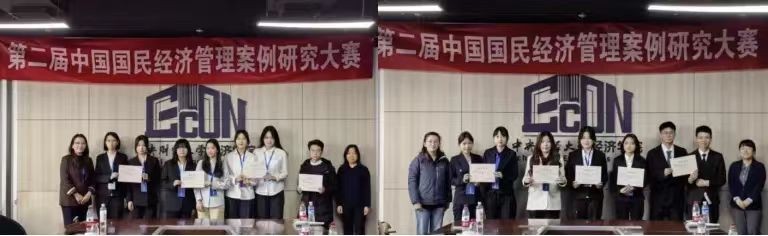
On November 15, 2025, the finals of the 2nd China National Economic Management Case Study Competition, hosted by the Central University of Finance and Economics, concluded in Beijing. Six finalist teams from the School of Economics at Liaoning University (LNU) distinguished themselves through their solid theoretical grounding, outstanding practical insights, and excellent presentation skills, securing two Second Prizes and four Third Prizes.
During the preparation phase, the School of Economics placed high priority on this event, viewing it as a vital benchmark for testing the construction achievements of the “National First-Class Undergraduate Major” in National Economic Management. Under the meticulous mentorship of faculty from the Department of National Economic Management, the teams spent months conducting in-depth field research. They closely integrated classroom theory with major national strategies, such as the digital economy, rural revitalization, and green development. From policy interpretation to proposing countermeasures, the students painstakingly refined their case texts and defense simulations. Every step of the process embodied the faculty and students’ persistent exploration of “real-world problems” and their rigorous academic pursuit.
At the finals, the LNU teams impressed the panel of judges with their clear logical frameworks, robust empirical data, and innovative policy recommendations. The six presented cases were attuned to the pulse of the era, balancing macro-strategic thinking with regional practical characteristics.
The two Second Prizes were awarded for: The Economic Logic of Intangible Cultural Heritage (ICH) Industrialization: Balancing Preservation and Economic Value in the New Era — A Case Study of Shenyang Shadow Puppetry (Team Members: Wang Yilin, Guo Zhenyu, Fu Yuhan), which focused on the challenges facing ICH industrialization and constructed a mechanism balancing cultural protection with economic viability; and From Pilot Project to Industry Promotion: A Study on Reform Experience Based on the National Carbon Peaking Pilot of Hangzhou Thermal Power (Team Members: Wang Luxuan, Wang Hongyue, Li Xiaoran, Cheng Yu), which contributed “youth wisdom” to the realization of the nation's “Dual Carbon” goals. The four Third Prizes covered a range of critical economic issues, including: “5G + Industrial Internet” Empowering High-Quality Development of the Real Economy: A Case Study of BMW Brilliance’s Digital Upgrade in Shenyang (Team Members: Tan Yu, Zhao Yuetong, Peng Zihan, Zhang Xiulin, Yan Bingyang), which analyzed the pathway by which “5G + Industrial Internet” empowers the digital transformation of the manufacturing sector; The Role Orientation and Practical Exploration of the “First-Store Economy” in Expanding Domestic Demand: A Case Study of Brand Incubation and Business District Upgrading in Beijing (Team Members: Fang Yintan, An Bo, Wang Yiqiao, Zhu Yixuan), exploring innovative practices in upgrading business districts within the strategic framework of expanding domestic demand; AI-Empowered Governance in Inclusive Finance: A Case Study Based on WeBank (Team Members: Sun Xue, Xu Ziting, Sun Xinyi, Yang Jingqi), which revealed the internal logic of AI in governing inclusive finance; and finally, Private Economy Development and Institutional Innovation: A Case Study of Deshi Group (Team Members: Gao Xinyi, Wang Yiran, Zong Yining), which summarized the “Northeast Experience” regarding institutional innovation in the private sector.