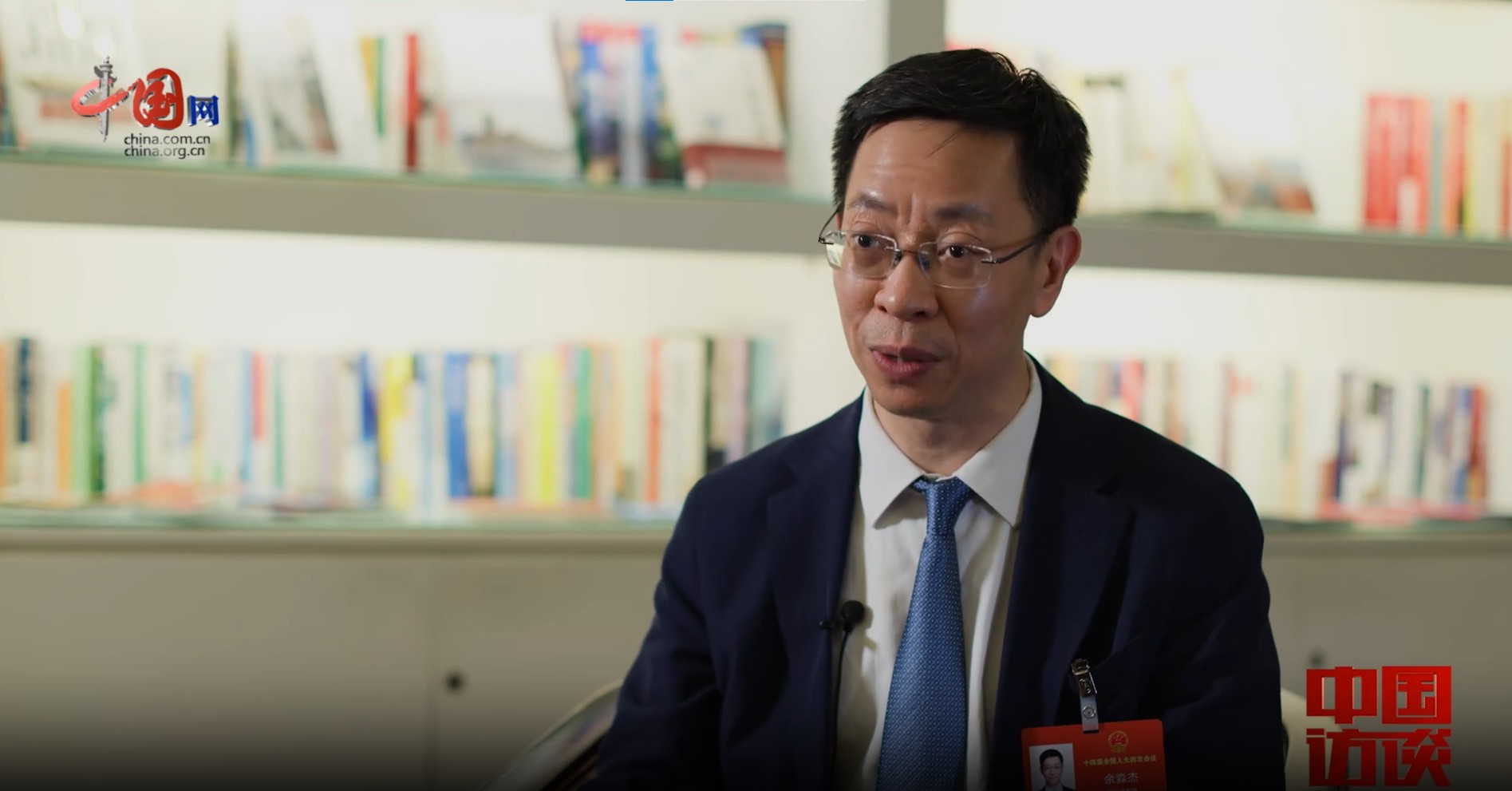
China.com: Hello everyone! This is China Talk, a special interview series for the 2026 Two Sessions by China.com. Since being written into the Report on the Work of the Government in 2025, “investing in people” has been successively included in the proposals for the 15th Five-Year Plan and the key arrangements of the 2025 Central Economic Work Conference. The development philosophy of “integrating investment in physical assets with investment in people” has been continuously deepened, becoming an important guideline for optimizing the investment structure and promoting high-quality development in the new development stage. The year 2026 marks the start of the 15th Five-Year Plan period. How can we translate the national strategy of “investing in people” into tangible people’s well-being that citizens can see and feel? How can we closely integrate high-quality development with a high-quality life? In today’s program, we have a special interview with Yu Miaojie, Deputy to the National People’s Congress, President of Liaoning University, and Fellow of the International Economic Association (IEA).
Yu Miaojie: Hello, friends from China.com! I’m Yu Miaojie from Liaoning University.
China.com: From a “strategic concept” to an “annual task,” and then established as a “long-term national policy,” what kind of shift in national macro-policy and development thinking does “Investing in People” reflect? What exactly is the investment philosophy behind “Investing in People”?
Yu Miaojie: This year’s 15th Five-Year Plan proposals, including the Government Economic Work Report, particularly emphasize “Investing in People,” which represents a very important change. From a broader perspective, “Investing in People” essentially returns to our core principle, which is the concept of “Putting the People First.” We have always been guided by Marxism. The most central viewpoint in Marxist political economy is precisely the concept of “Investing in People,” or “humanization,” “Putting the People First,” and “taking the people as the foundation.”
China.com: The 15th Five-Year Plan proposals emphasize the close integration of “investment in physical assets” and “investment in people.” How should we understand this “integration”? What principles need to be grasped, and how can synergistic efforts be achieved?
Yu Miaojie: Previously, we placed particular emphasis on “investment in physical assets.” Now, the emphasis is on “investing in people.” Why this shift? If “investment in physical assets” keeps increasing, its marginal contribution diminishes. In other words, the contribution of the first unit of investment might be significant, but the contribution of subsequent units becomes smaller. In economics, this is called the “law of diminishing marginal returns.” Precisely because of this, to promote China’s high-quality economic development, there is now a greater need to explore new modes of investment. “Investing in People” emerged against this backdrop.
However, we must also note that “investment in physical assets” and “investing in people” are not isolated; they are dialectically unified. For example, investing in universities, increasing per-student funding, is “investing in people.” Helping universities build dormitories through policies like the “Two Key Projects, Two New Initiatives” is “investment in physical assets.” Therefore, combining “investment in physical assets” with “investing in people” can better achieve high-quality economic development.
China.com: So, “investment in physical assets” serves human development, and human development also requires material support.
Yu Miaojie: Exactly right!
China.com: Adhering to the principle of “closely integrating investment in physical assets and investment in people” represents an enhancement and optimization of China’s investment philosophy, direction, and priorities. It holds significant meaning for strengthening development momentum, expanding domestic demand, and promoting well-rounded human development. How do you view the historical context and strategic significance behind the proposal of “Investing in People”?
Yu Miaojie: As mentioned earlier, I believe the proposal of the “Investing in People” concept is, in fact, the concrete implementation of the “Putting the People First” principle. The previous goal was to ensure rapid economic growth, but now “high-speed growth” has transformed into “high-quality development.” High-quality development is not only about material civilization but, more importantly, about the co-construction of both material and spiritual civilization. From this perspective, “Investing in People” serves the construction of our spiritual civilization. Because only when the builders and laborers of socialism possess higher quality and greater human capital can our socialist construction proceed steadily and go far. That’s the first aspect.
Secondly, consider what kind of modern socialist powerhouse we aim to build. We aim to build a prosperous, strong, democratic, culturally advanced, harmonious, and beautiful modern socialist country. From this perspective, “Investing in People” is fundamental because people are the primary focus. Only by achieving this can we truly realize that goal. In the context of Marxist political economy, it’s not just about “materialization” but “humanization.”
China.com: The deployments in the 15th Five-Year Plan proposals send a strong policy signal to direct more financial resources towards “investing in people,” such as increasing the proportion of government investment in people’s livelihoods and improving the layout of infrastructure and public service facilities. Where will these funds come from? This is a practical challenge. What suggestions do you have for building a healthy and sustainable investment mechanism?
Yu Miaojie: This can be viewed from two aspects: scale and structure. In terms of scale, we are currently adopting a more proactive fiscal policy and a moderately accommodative monetary policy. For example, policies like the “Two Key Projects, Two New Initiatives” actually provide more funds.
Secondly, structural adjustment. To put it simply, originally, a certain amount of money, say, could build 10 kilometers of highway. Now, investing that same amount in education, in cultivating people, constitutes “investing in people.” So, this is a change in structure. Therefore, my core viewpoint is that we can better implement “Investing in People” by increasing the overall scale and optimizing the structure.
China.com: Are there any exemplary cases in this area, or some good, innovative methods and approaches?
Yu Miaojie: Let me give an example from my own institution, Liaoning University. Over the past three years, we have introduced and cultivated a large number of talents. I often say a few phrases: “Northeast China is a great place, Liaoning is a treasure basin, and Liaoning University is a phoenix tree.” So, we have massively attracted such talents. As you can see, in the past three years, for our Double First-Class discipline in Economics, we not only achieved zero breakthroughs in publications in international top-tier journals but have also published 18 papers in such journals over three years, which is twice as many as some Project 985 universities. Where there’s a will, there’s a way. As long as we have such policies and such determination, talents will come.
China.com: China practices a people-centered development philosophy. The ultimate purpose of investing in people is to serve the people. How can it fundamentally resolve the “disconnect” between economic development and the improvement of people’s livelihoods, forming a virtuous cycle between economic growth and livelihood enhancement? What kind of economic growth model and social form will it ultimately shape?
Yu Miaojie: We now particularly emphasize high-quality development. “High-quality development” means not merely pursuing GDP growth. Economic GDP growth must be combined with the improvement of people’s livelihoods. There should be no “temperature gap” in perception between the macro and micro levels. How to achieve this? Through the improvement of people’s livelihoods. How to improve livelihoods? How to improve livelihoods through “Investing in People”? Let me give a few examples. For instance, in education, starting with higher education, a very important aspect is expanding quality undergraduate enrollment. In simple terms, for young people today, getting into university is not as difficult as it was in our time; it’s relatively easier now. The key is being able to attend a good university. Current national policies aim to allocate more admission slots to these high-quality undergraduate institutions, guiding more young people to benefit from the influence of renowned scholars and masters. That’s the first point.
Secondly, for secondary education, the state also particularly emphasizes increasing the supply of high school placements. This is very correct. Personally, I believe the policy of tracking after junior high school entrance exams should be re-examined. My core view is that young people, for example, a child from grades 7 to 9, especially boys who might be more playful, may not be able to settle down to study. But if they have the opportunity to attend high school, it could be different. From this perspective, if they don’t have such an opportunity and are tracked early, we might lose a potential scientist or talent in various fields. I personally believe we should be cautious about the tracking after junior high and simultaneously increase the supply of high school placements, which is also very important.
Regarding employment, support for flexible employment should be further strengthened. For example, a specific manifestation of “Investing in People” for people’s livelihoods is the optimization of holidays. Originally, it might have been 5 days; now, can it become 10? Can paid leave be implemented better? This would give young people more rest time, simultaneously creating more space and time for consumption, which could also effectively stimulate economic development. These are all examples of coordinating “Investing in People” with serving socio-economic development. I believe it can be done.
China.com: We hope that during the 15th Five-Year Plan period, “Investing in People” will enable the well-rounded development of individuals to achieve better and more long-term progress. Thank you, Deputy Yu, for accepting our interview.
Yu Miaojie: Thank you! Yes, I also believe China’s economy will have a better tomorrow, and people’s lives will be better tomorrow too!
Original link:
http://fangtan.china.com.cn/2026-03/08/content_118370164.htm