Recently, China Daily featured the significant archaeological discoveries made by Professor Xu Ting from Liaoning University. The report highlights his team's systematic research on the Changbai Mountain Paleolithic sites, revealing how early humans utilized volcanic obsidian to survive in the harsh northern landscape over 50,000 years ago. The full text of the report is as follows:
Tracing footsteps in volcanic stone
Changbai Mountain research reveals how obsidian helped humans survive an unforgiving northern landscape over 50,000 years ago, report Wang Ru and Liu Mingtai.
By Wang Ru and Li Mingtai | China Daily

A distant view of Changbai Mountain in Jilin province from the Fenglin site. Excavations at the site have yielded rich collections of stone tools and animal fossils. [Photo provided to China Daily]
After decades of uncertainty, a major archaeological program in Northeast China's Changbai Mountain area in Jilin province has finally pieced together a coherent account of human life centered on a volcanic glass called obsidian.
Since the 1990s, researchers have identified numerous Paleolithic sites across eastern Jilin, many yielding tools made from this volcanic glass. However, without coordinated excavation and analysis, they struggled to determine how the sites related to one another, their chronology and cultural nature.
That picture is now changing.
In 2021, under a major academic program named "Changbai Mountain Paleolithic site group in east Jilin province", archaeologists began conducting systematic studies on the sites. Their efforts have greatly enhanced understanding of this area's role in the Paleolithic era, unveiling a long tale of how early humans lived in this demanding environment and used local resources to survive and adapt.
The scale is significant. Covering more than 100,000 square kilometers, the program has surveyed over 6,500 sq km in just five years, identifying more than 1,000 locations containing chipped stone tools, most of which are believed to be related to Paleolithic human activities, says Xu Ting, an archaeology professor at Liaoning University and secretary of the program.
The density of discoveries has overturned earlier assumptions that only small groups passed through the region with limited activity. Instead, the evidence points to sustained and widespread human presence.
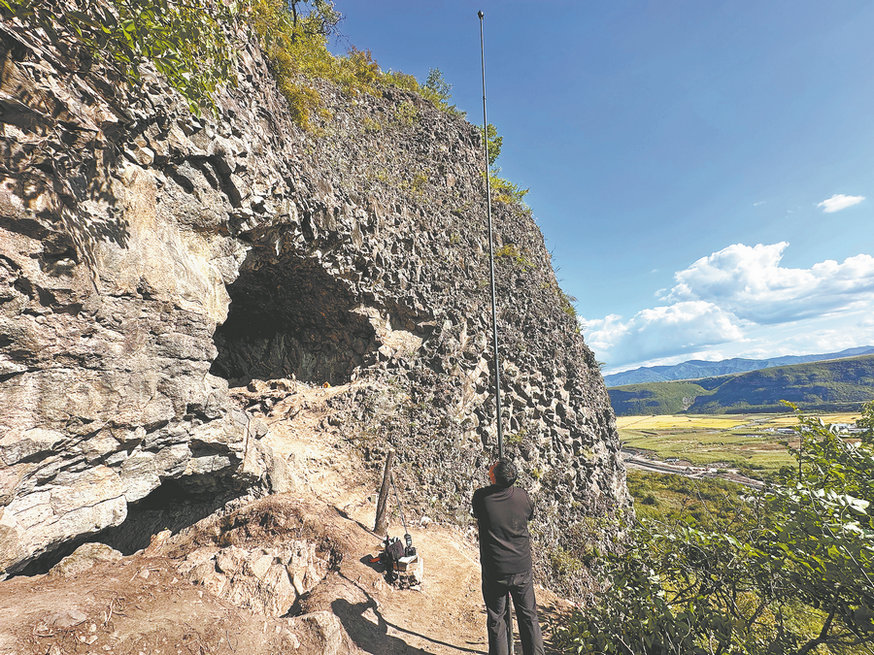
A researcher measures the size of a cave for mapping at the Shangtiandong site in Helong, Jilin province. [Photo provided to China Daily]
Excavations at five major sites — Dadong, Jidi and Shangtiandong in Helong, Fenglin in Baishan, and Xianrendong in Huadian — have yielded rich collections of stone tools and animal fossils, Xu says. Taken together, these sites establish a cultural sequence spanning roughly 220,000 to 15,000 years ago.
For example, Xianrendong pushes the timeline of human activity in the region to about 220,000 years ago. Later sites, including Dadong (50,000-15,000 years ago) and Fenglin (24,000-17,000 years ago), document the emergence and refinement of microblade techniques from around 28,000 years ago. Shangtiandong captures a transitional phase between the Paleolithic and Neolithic eras, from 15,000 years ago to the Bronze Age, with finds that include bones likely used in early ritual practices.
"Therefore, we have generally built a cultural sequence of this area, so that we now know the earliest human activity traces, what stone tools ancient people used at different times, and what cultural characteristics were demonstrated in each phase," says Xu.
Located in Northeast Asia, this area was a key position in human evolution and migration during the prehistoric era. "Geographically, the region sits at a natural crossroads," says Xu. "To the east lies the Russian Far East, to the south, it links the Korean Peninsula. To the west, it can connect through western Liaoning province or western Jilin to the northern grasslands and North China."
Nature itself played a decisive role in shaping life here. Frequent volcanic activity produced abundant obsidian, an ideal material for toolmaking due to its hardness, uniform structure and durability. At the same time, volcanic ash enriched the soil, supporting diverse plant life and attracting animals. Together, these factors created an environment rich in resources despite harsh climatic conditions.
Some of the sites contain evidence of people who lived during the Last Glacial Maximum (approximately 26,500 to 19,000 years ago, when ice sheets and glaciers reached their greatest extent). Archaeologists suggest the appearance of microblade tools helped communities adapt to the environment.
"We believe people in the Paleolithic period lived a hunter-gatherer lifestyle. During colder phases, when resources became scarce, they would have expanded their range to secure what they needed. The microblade tools were easy to carry, so they could satisfy people's need to migrate long distances," says Xu.
"With a microblade core and a stone hammer, people could produce a steady supply of tools. These could be used as hunting implements, significantly improving their chances of survival," he adds.
Xu also notes that micro-trace analysis suggests some tools were versatile, allowing people to carry the minimum number to meet their needs during migration.
More importantly, they have conducted detailed research on the obsidian found at the sites. Xu says that since this material has varying internal chemical components when formed by volcanic eruptions in different periods or regions, microanalysis can trace its source.
"At Dadong, we've found obsidian from multiple origins. Much of it comes from areas around Tianchi Lake on Changbai Mountain and nearby regions, but a small portion can be traced to the Russian Far East. That tells us people were able to obtain materials from considerable distances," says Xu.
Li Feng, a researcher at the School of Archaeology and Museology at Peking University who also takes part in the program, says that in their source-tracing studies, they discovered some volcanic eruption sites where obsidian deposits were exposed, while other rocks were eroded by rivers and deposited in riverbeds.
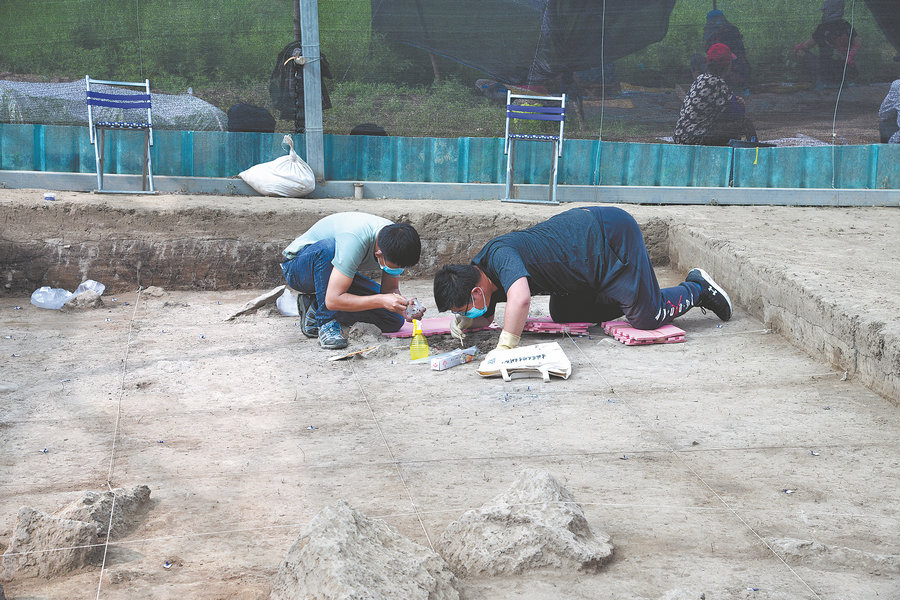
Technicians clean the Dadong site in Helong. [Photo provided to China Daily]
"In the earlier phase at Dadong, people mainly used obsidian collected from nearby riverbeds. Later, they began sourcing the material from primary volcanic deposits, about 200 km from the site. This suggests their activity range expanded significantly," says Li.
Xu notes that this growing mobility fits into a broader regional pattern. Earlier studies by researchers in China and abroad have shown that obsidian from the Changbai Mountain area reached as far as present-day Shanxi province around 40,000 years ago, and also appeared at numerous sites on the Korean Peninsula, suggesting a circulation network of this special material across Northeast Asia.
"How did the material travel over such long distances? It is possible that it moved through multiple exchanges between different groups of people," says Xu.
"Our work actually plays a very significant role in understanding the entire obsidian exchange and circulation network across Northeast Asia, with the Changbai Mountain region at its core," he says, adding that international cooperation is underway to gain more understanding of the overall scenario.
Wang Youping, an archaeology professor at Peking University, says the Paleolithic industry dominated by obsidian lithic materials in this area is an extremely rare discovery among Paleolithic sites in China. At the same time, several findings are challenging long-held assumptions. At the Dadong site, archaeologists uncovered polished stone tools, which are often believed to be a sign of Neolithic human activities, dating back roughly 27,000 years. The discovery may offer new clues about how and when polishing techniques first emerged.
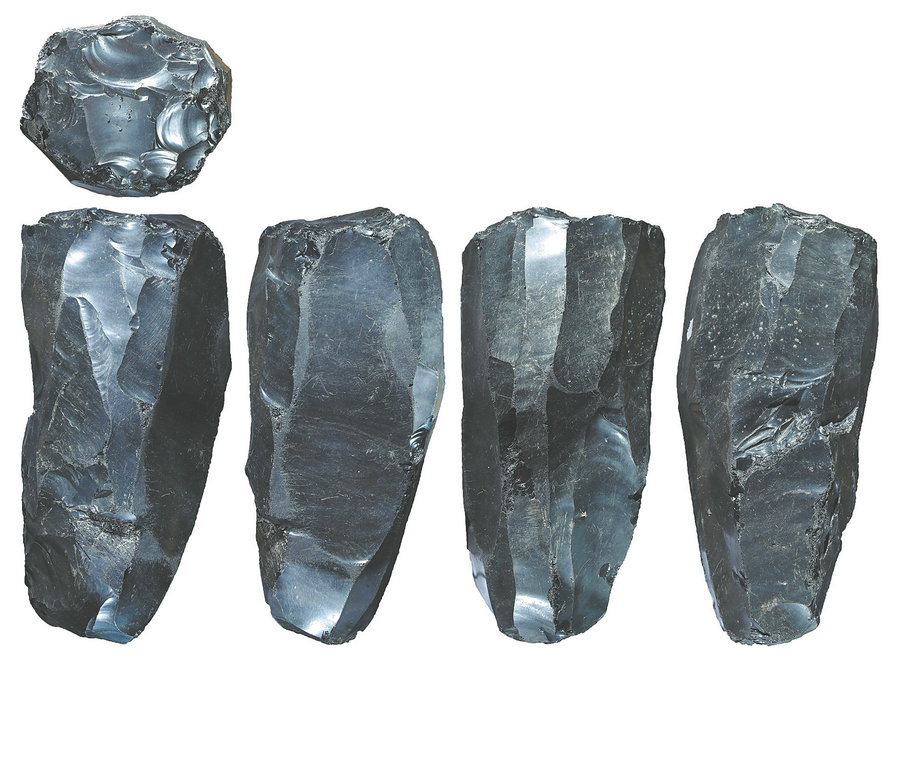
Blade cores recently discovered in an archaeological survey in Antu county, Jilin. [Photo provided to China Daily]
At the Jidi site, archaeologists found a giant blade core (a mother tool used for detaching blades) measuring 53 centimeters in length. Its scale and craftsmanship are rarely found anywhere in the world, says Xu. Together, the sites provide a continuous record of human activity from about 220,000 to 15,000 years ago.
By at least 50,000 years ago, people were already deliberately selecting obsidian for tool production. Around 28,000 years ago, they developed blade and microblade technologies that improved efficiency, mobility, and adaptability.
"Overall, with abundant obsidian and animal and plant resources, ancient people in the Changbai Mountain area thrived and developed from 220,000 to 15,000 years ago. Through continuous technological advances, they gradually refined their skills and eventually entered the Neolithic period around 15,000 years ago," says Xu.