Recently, a paper entitled “One-for-All Community Search on Unseen Graphs” — jointly completed by Lecturer Li Mo (first author), Professor Ding Linlin (corresponding author) and master’s student Zhao Zhaosong from the Faculty of Information, Liaoning University, in collaboration with Professor Renata from the University of Melbourne (Australia), Dr. Yao Zhongming from Aalborg University (Denmark) and Professor Li Jianxin from Edith Cowan University (Australia) — has been accepted as a Full Paper for the main conference of SIGIR 2026. As a CCF A-class top international conference, SIGIR is also recognized as a Class A landmark paper at Liaoning University, with an acceptance rate of only 18.4% in 2026 and significant influence in the fields of information retrieval and data mining. This publication fully reflects the innovative ability and research strength of the Faculty of Information in addressing real-world social problems through research on information retrieval and graph data mining.
This research focuses on the community search problem in graph data mining. To address the common limitations of existing learning-based algorithms—such as strong data dependency, high training costs, and limited generalization ability, which typically require retraining or fine-tuning for each target graph—it proposes a cross-dataset universal community search method for homogeneous graphs. The method only needs to be trained once on the source dataset and can then be directly transferred to perform a community search on any unseen graph, without retraining or additional fine-tuning.
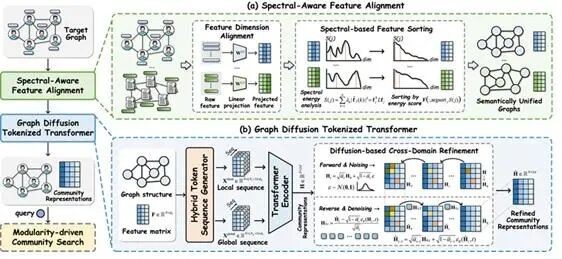
In terms of method design, this study proposes a spectrum-aware feature alignment module to unify cross-graph feature dimensions and align community-related semantics. On this basis, a graph diffusion Transformer model is further constructed to integrate local and global structural information for capturing high-order dependencies, and refines representations via a diffusion mechanism, thereby effectively alleviating the distribution shift problem on unseen graphs. Experimental results demonstrate that the proposed method achieves strong cross-domain generalization ability without target-domain supervision, and outperforms existing approaches by 7.92% in performance under cross-dataset experimental settings.