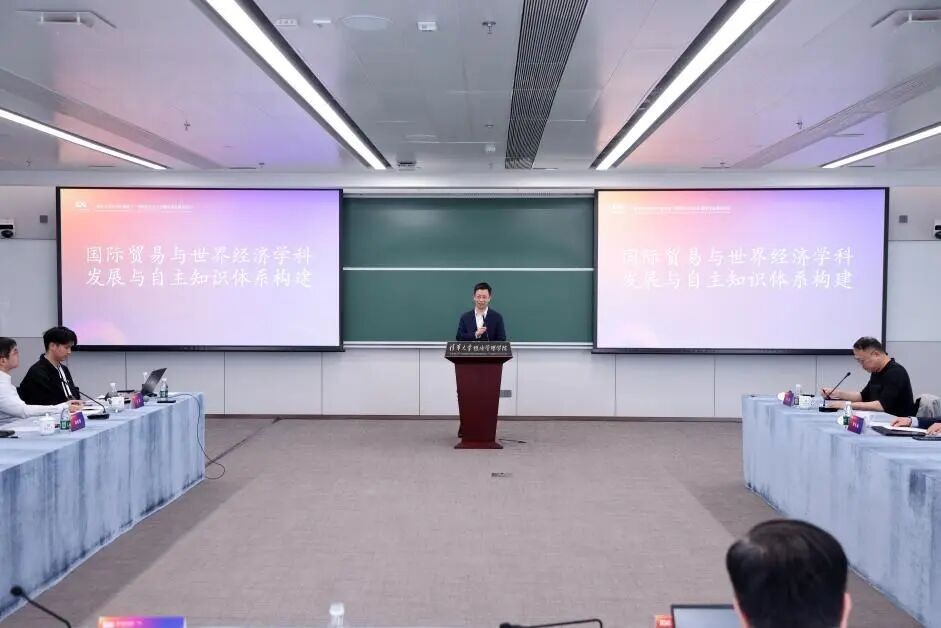
On April 11, the Centennial Celebration of the Economics Department of Tsinghua University and the Discipline Development Symposium were held at the School of Economics and Management, Tsinghua University. Yu Miaojie, Deputy Secretary of the Party Committee and President of Liaoning University, was invited to attend the event and delivered a keynote speech at the sub-forum themed “The Development of International Trade and World Economics Disciplines and the Construction of an Independent Knowledge System”. The content of the speech is as follows (transcribed from audio recording):
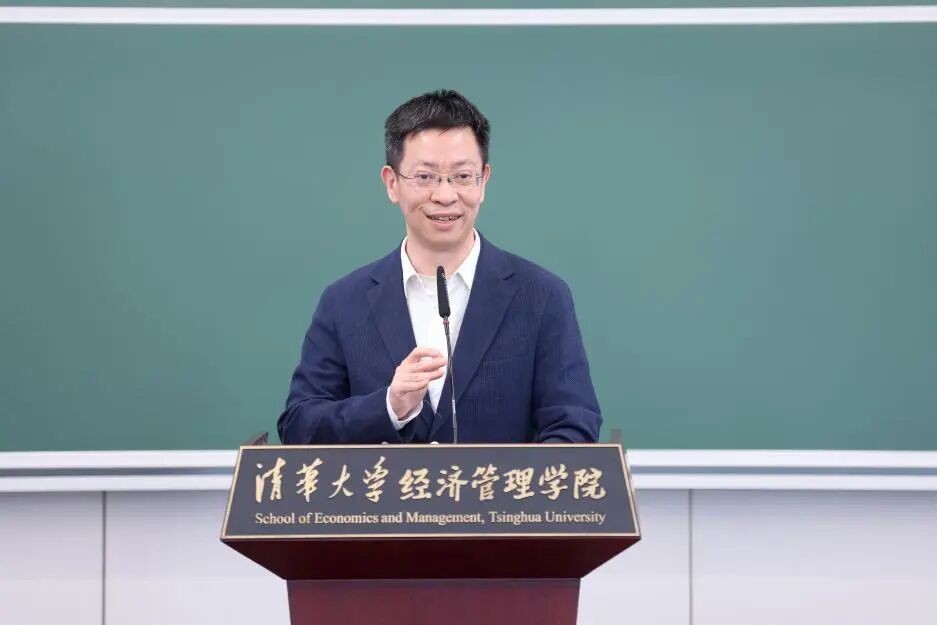
Let me share my thoughts on two questions regarding the construction of China’s economic discipline, especially the construction of an independent knowledge system for international trade: Firstly, why should we build it? Secondly, what should we build?
Why should we build it? Suppose a foreign scholar asks: Why build an independent knowledge system for China’s economics? Why build an independent knowledge system for international trade? And how would we answer this question?
Firstly, why should we build an independent knowledge system for China's economics? I believe there are two aspects that traditional Western economics cannot explain.
To begin with, how can we explain China’s rapid economic development? Most people tend to attribute it to China’s marketization and internationalization. While this reasoning contains some truth, upon closer examination, these are necessary but not sufficient conditions. The Philippines, for example, has also pursued internationalization. So why has China developed so well while other countries have not? In my view, beyond marketization and internationalization, the role of the government is also crucial—what we call the combination of an effective market and a capable government. Some scholars might argue that Western economics also emphasizes the role of government, and that macroeconomics exists within it. However, I believe Keynesian macroeconomics is a short-term theory addressing insufficient effective demand. In other words, it does not describe a long-term state; in the long run, the economy returns to the Marshallian framework. This suggests that Keynesian theory applies only to short-term phenomena. Moreover, China’s economy has now gone through 75 years of development and implemented 15 Five-Year Plans. This year in particular, the Law of the People’s Republic of China on National Development Plans has become national legislation. This is not a choice, but a necessity. From this perspective, China follows a system of long-term planned development, which may be precisely why the short-term, demand-side shock theories of Western economics fall short in explaining China's experience.
Turning to the second question: why should we build an independent knowledge system for international trade? International trade occupies a very important place in Western economics, yet I believe there are two aspects that it fails to explain adequately. One aspect is the role of a country or a government in independent liberalization. For example, beyond the policies required for WTO accession, China has implemented a vast array of reform and opening-up measures. In my view, the most distinctive feature is that China's opening-up has been gradual—a regionally progressive opening, expanding from points to lines and then to broader areas. From both a temporal and a geographic dimension, the government has played a role that goes beyond what the WTO requires. Another aspect is that real-world social development is outpacing theoretical development. Take the relationship between exports and FDI. According to the Heckscher-Ohlin model in modern economics, exports and FDI are substitutes. From the perspective of vertical specialization, they are complements. But is there a unified framework that can bring these together? For instance, how does a firm decide on the optimal mix of horizontal FDI versus vertical FDI? I believe no such unified framework exists—and that is precisely the problem.
What kind of independent knowledge system should we build? Or more specifically, what kind of independent knowledge system for international trade should we build? Regarding what kind of independent knowledge system for economics we should build, there is currently a certain viewpoint that requires us to achieve some conceptual clarity. If this considered correct, it would have a significant impact on much of our research. The viewpoint is this: “Over the past several decades, China's economics has made no major contributions of its own; it has merely copied Western theories and added a few remarks about Chinese characteristics.” To begin with, I believe this assertion is incorrect. Why? Because China’s economy is a market economy with Chinese characteristics. Since it is a market economy, Western theories such as supply and demand theory, general equilibrium theory, partial equilibrium theory, and information economics all have their applications. Therefore, we must draw on these analytical tools. Secondly, China is different from Western countries. Thus, we must study the market economy with Chinese characteristics. I believe the market economy with Chinese characteristics is extremely important, but our efforts remain insufficient. In what ways are they insufficient? There is a term: the socialist market economy with Chinese characteristics. We have done a great deal of research on the market economy with Chinese characteristics, but we have done insufficient research on the socialist attributes of that market economy. This leads to three key insights: Firstly, our earlier work has largely focused on aggregate-level stories—stories about how to make the economic pie bigger, rather than stories about how to distribute the pie. Secondly, the approach to constructing China’s economics should start from the perspective of distribution, or how to achieve better distribution. We should not look at distribution in isolation. Instead, we should examine how policies affect the real economy, and then how they in turn affect people. In other words, we need to shift from a material-dimension analysis to a human-dimension exploration. Thirdly, we should first study the impact on firms, and then study the impact on people, on health, education, wage inequality, and so on.
Regarding what we should do about independent opening-up in international trade, I see two dimensions: first, building a theoretical system of independent opening-up; second, examining its economic and social impact.
On the one hand, research on independent opening-up can be approached at five levels: how enterprises advance independent opening-up and how national policies assist them, such as research on export credit; the impact on industries, such as export rebates; the impact on regions, such as the Hainan Free Trade Port as a whole; the impact on the nation, such as how a country adjusts its tariff and non-tariff barriers amid Sino-US trade competition; and the construction of international public goods, such as the Belt and Road Initiative in the short term and the building of a community with a shared future for mankind in the long term. The theoretical framework for independent opening-up should therefore be developed along these five levels.
On the other hand, the impact of opening-up on the economy and society aligns with the five key development concepts: innovation, coordination, sharing, and green development, an area with great potential and tangible opportunities for research. From a higher perspective, while previous research has focused more on the impact of opening-up on production, we should emphasize its effects on production, distribution, circulation, and consumption. The impact on production and circulation has been extensively studied, for example, building a unified domestic market and promoting the dual circulation of domestic and international markets. The impact of opening-up on consumption is largely realized through its impact on distribution—such as how changes in wages for white-collar and blue-collar workers affect their consumption expenditures. How does a surplus in goods trade transform into a deficit in services trade? When entrepreneurs send their children abroad for education, that is precisely the conversion of a goods trade surplus into a services trade deficit. These are all worthy lines of inquiry. The task of building China’s economic discipline and an independent knowledge system for international trade remains a long and arduous one. Let us work together for it.
Thank you.