
The China-US trade friction since 2018 has not only profoundly changed the political and economic relations between the two countries but also had a far-reaching impact on the global economic landscape.
On this topic, this post introduces the paper China-US Trade War: Firm Import-Export Relation Along Global Supply Chains, published in the International Journal of Industrial Organization in January 2026, co-authored by Tian Wei (Peking University), Yu Miaojie (Liaoning University), and Zheng Chunru (University of Virginia).
Research Background
Since July 2018, the United States has imposed tariff increases on Chinese goods exported to the U.S. in three rounds, targeting US$50 billion, US$200 billion, and US$300 billion worth of products respectively. In response, China proportionally imposed retaliatory tariffs on U.S. goods exported to China, covering US$50 billion, US$60 billion, and US$75 billion, respectively. As the trade war progressed, existing empirical studies have primarily focused on the effects of tariff incidence, including bilateral trade flow losses, changes in import or export prices, domestic production, investment, consumption and social welfare.
Among these studies, at least two core questions have yet to receive definitive answers. The first is that both China and the U.S. experienced a rather unexpected phenomenon in the trade war: the imposed tariffs were almost fully passed through to post‑tariff import prices, yet estimation results at different levels of data aggregation may not be consistent. More importantly, unlike multilateral tariff reductions such as those following China’s WTO accession (which applied to all trading partners), the China‑U.S. trade war was bilateral, targeting specific product lines of a single major trading partner. This raised a new question: whether firms re‑optimize their import structures across trading partners and products. Given this background, this paper used firm‑level data from 2016 to 2019 to examine the impact of China’s retaliatory tariffs on U.S. goods.
Empirical Strategy
(1) Regression Model
This paper employs an event study approach to examine the anticipatory effects of firms’ export behavior, and constructs the following model:

In the equation, firm fixed effects and quarter fixed effects are controlled, while also accounting for the impact of U.S. export tariffs (weighted by the value of each firm's export products to the U.S.) and imports of intermediate inputs from other countries. We examine the effect of tariffs on firm exports, including exports to the U.S., exports to the rest of the world, and total exports to all countries. Standard errors are clustered at the firm–quarter level, and 95% confidence intervals are reported.
(2) Data Sources
This paper uses monthly disaggregated trade transaction data from the General Administration of Customs of China from January 2016 to December 2019. The dataset provides information on transaction prices, quantities, and values at the HS 8‑digit product level for each trading firm, as well as firm‑level information on import source countries, export destinations, product values, quantities, unit prices, and trade regimes. Its greatest advantage lies in the inclusion of firm identifiers,
Research Findings
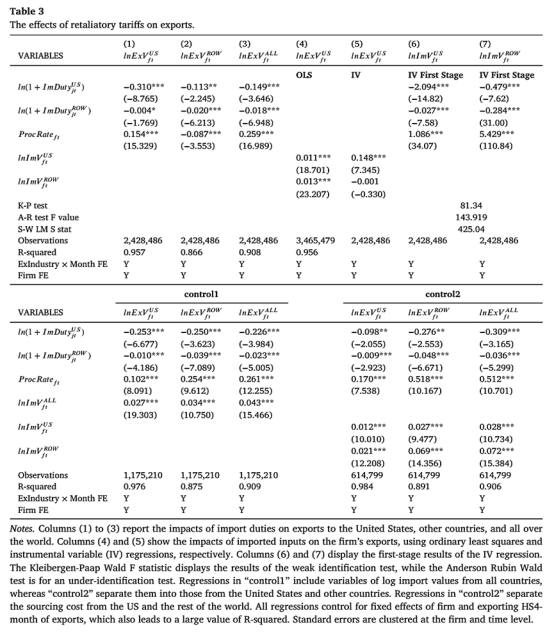
In the baseline regressions, we control for firm fixed effects as well as “export industry times month” fixed effects, thereby eliminating the confounding influences of U.S. tariffs on Chinese exports, industry‑specific demand shifts, transportation cost changes, industrial policy adjustments, exchange rate fluctuations, and other common factors. At the same time, given that many multi product trading intermediaries in China are not directly engaged in industrial production, we exclude firms whose names contain “import,” “export,” or “trade,” as well as firms with an unusually wide range of export products, in order to more accurately identify the responses of manufacturing firms. The baseline results show that an increase in U.S. import tariffs not only reduces firms’ exports to the U.S. but also suppresses their exports to the rest of the world. Specifically, a 10% increase in the relevant U.S. import tariffs leads to an approximately 3.1% decline in firms’ exports to the U.S. and a 1.13% decline in exports to other countries. This implies that firms did not systematically hedge against losses in U.S. exports by “switching to other markets.” Instead, the import cost shock, transmitted through firms’ internal production and sourcing linkages, generated a broader export contraction effect.
In the instrumental variable estimation, the authors further exploit industry‑level import tariff changes to identify the causal effect of imported intermediate inputs on exports. The results show that imported intermediate inputs from both the United States and other countries are generally positively correlated with firm exports. However, when procurement costs are raised by tariffs, this positive relationship turns into a negative impact on exports. In other words, imported intermediate inputs are an important condition supporting firm exports, and the trade war indirectly weakens firms’ export capacity by raising the cost of these inputs.
Mechanism Analysis
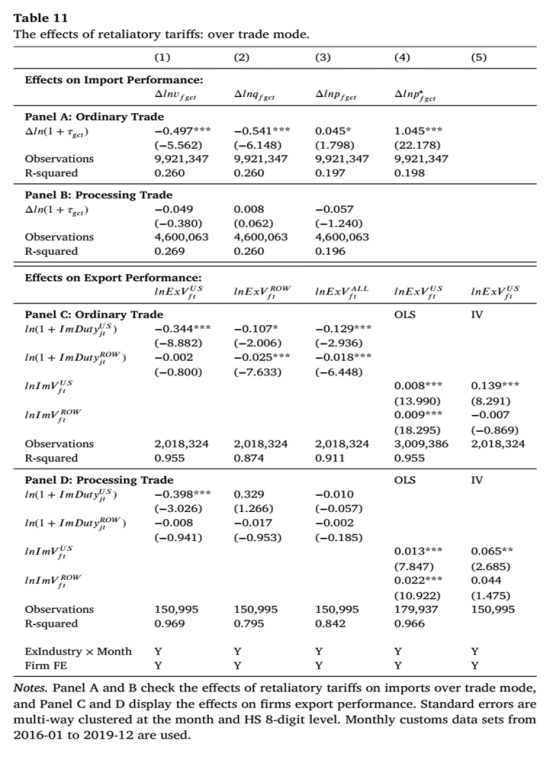
This paper discusses the special role of processing trade in China’s trade system. Unlike the United States, about 40% of China’s imports are intermediate inputs used in processing trade to serve export‑oriented production. The most important institutional feature of processing trade is that, even during the trade war, such imports generally enjoy zero tariffs. Specifically, this paper first compares changes in imports of targeted versus non‑targeted products under different trade regimes. For ordinary trade, targeted products show a clear drop in the month the tariff takes effect, while non‑targeted products exhibit a much smoother change. For processing trade, which is exempt from tariffs, no such consistent difference appears between targeted and non‑targeted products. Further analysis finds that after the outbreak of the trade war, some firms engaging in both ordinary trade and processing trade (so‑called hybrid firms) switch to pure processing trade to avoid additional import tariffs. For firms eligible to engage in processing trade, this trade‑regime switch becomes an important mechanism to cushion the tariff shock. At the export level, the authors compare pure ordinary‑trade firms and pure processing‑trade firms. The results show that the impact of import tariffs on the exports of processing‑trade firms is generally insignificant, even though such firms rely heavily on imported inputs for their exports. This finding suggests that the processing trade regime acted as a kind of “protective institutional arrangement” for China during the trade war. In other words, without the tariff exemption for processing trade, both China’s imports and exports would likely have contracted much more severely.
Conclusions
Using firm-level customs data, this paper estimates the impact of China’s retaliatory tariffs on import and export behavior during the China‑U.S. trade war. The main findings are as follows. First, regarding the pass, through of China’s retaliatory tariffs, this paper finds that firms adjust their trade war import baskets to mitigate the increase in procurement costs.
Second, this paper examines the consequences of such import basket contraction and adjustment through firms’ internal “import-export linkage.” It finds that retaliatory tariffs not only reduce firms’ exports to the U.S. but also compress their exports to other countries. Moreover, the export decline is more pronounced for firms that rely more heavily on foreign sourcing, especially those reliant on differentiated inputs.
Third, further analysis shows that the costs of higher import tariffs accumulate along global production chains and affect firms differently depending on their position in the chain. Specifically, retaliatory tariffs imposed on upstream imports further depress firms’ final exports. Rising international sourcing costs accumulate layer by layer from upstream to downstream stages, thus exerting a stronger negative effect on the exports of downstream firms.

Scan the code for the link of the article