Recently, a research team led by Associate Professor Chu Zhenming from the School of Physics at Liaoning University (LNU) has achieved significant progress in the study of fabric-based flexible strain sensors. Their findings, titled “Multifunctional Janus-Structured Conductive Fabric with Environment-Adaptive Wettability Switching and Strain Sensing for Wearable Electronics” (DOI:10.1002/adfm.75680), have been published in the prestigious journal Advanced Functional Materials. With an Impact Factor of 19.0 for 2025, this journal is a top-tier publication in the fields of materials science and condensed matter physics. This work was supported by the National Natural Science Foundation of China, the Natural Science Foundation of Liaoning Province, and the Basic Scientific Research Project of the Educational Department of Liaoning Province.
Overview of the Paper
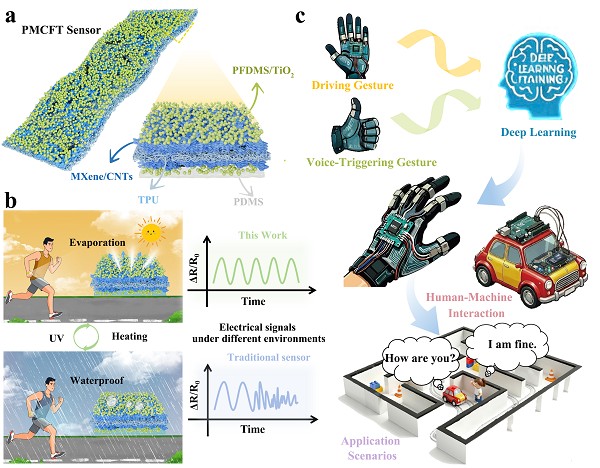
Skin-interfaced electronic devices based on impermeable substrates and stacked structures often suffer from poor sweat permeability and insufficient mechanical matching between layers, posing significant obstacles to long-term wearing comfort and stability. To address these challenges, this study developed a multifunctional Janus-structured strain sensor based on thermoplastic polyurethane (TPU)/MXene-carbon nanotube composites using a simple swelling and in-situ adsorption process. The sensor features a hydrophobic inner layer and a tunable wetting outer layer, enabling directional liquid transport and dynamic environmental adaptability. It demonstrates excellent comprehensive sensing performance, with a strain detection range of 0–150%, a gauge factor (sensitivity coefficient) of 194.575, and remarkable stability over 8,000 consecutive testing cycles. Furthermore, the underlying sensing mechanism was elucidated by combining micro-level analysis with macro-structural evolution studies. Beyond accurately monitoring human motion signals, the sensor achieved a high-precision sign language recognition rate of 97.53% with the assistance of machine learning algorithms. Additionally, by integrating the sensor into a control glove, wireless operation of a mechanical vehicle was realized, demonstrating its potential applications in human-computer interaction.
Author Information

Chu Zhenming is an Associate Professor and a Master’s Supervisor of the School of Physics. He serves as a peer reviewer for the National Natural Science Foundation of China (NSFC), an expert for the National Graduate Education Evaluation and Monitoring Expert Database, and a reviewer for the National Undergraduate Graduation Thesis (Design) Sampling Inspection Expert Database. Recognized as a “Top-notch Talent” in Shenyang, he is a member of both the Provincial Key Laboratory of Optoelectronic Functional Devices and Detection Technology and the Shenyang Key Laboratory of Materials Physics. His primary research interests include flexible wearable sensors, nano-functional materials, and superhydrophobic interfacial materials. He has presided over or participated in more than 10 NSFC and provincial/ministerial-level projects, published over 30 SCI papers in renowned international journals such as Advanced Functional Materials, Small, Chemical Engineering Journal, Journal of Materials Chemistry A, and ACS Applied Materials & Interfaces, and has been granted or filed more than 20 national invention patents.

Li Hongjin is a postgraduate student majoring in Condensed Matter Physics (the 2023 cohort). Her research focuses on the fabrication and performance of MXene-based Janus-structured fabric strain sensors. During her master’s program, she has published one SCI paper and filed one national invention patent application.