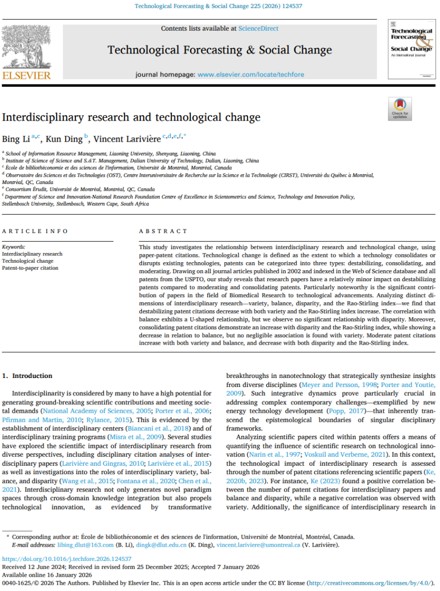
Recently, Li Bing of the Faculty of History published “Interdisciplinary research and technological change” as first author in Technological Forecasting and Social Change, a leading management journal (CAS Zone 1 Top journal, ABS 3-star, impact factor 13.5).
About the Paper
This paper argues that interdisciplinary research does not drive technological innovation in a single way. Rather, it produces different effects on different types of technological change through several mechanisms: the variety of knowledge sources, the balance of knowledge distribution, and the cognitive distance between disciplines. From a science – technology linkage perspective, the study uses paper-patent citations and dynamic patent citation networks. It applies the CD index to classify patents into three types: consolidating, destabilizing, and moderating, and examines how scientific papers, particularly interdisciplinary ones, function in different processes of technological change. Drawing on journal articles indexed in Web of Science and patents from the United States Patent and Trademark Office (USPTO), the study finds that scientific papers have a relatively minor impact on destablizing patents compared to moderating and consolidating patents. Particularly noteworthy is the significant contribution of papers in the field of Biomedical Research to technological advancements, which shows a strong potential for turning scientific knowledge into technology. Moreover, interdisciplinary research is more likely than non-interdisciplinary research to influence technological change, but its different dimensions do not all work in the same direction. Notably, a higher degree of interdisciplinarity does not necessarily lead to a stronger destabilizing impact. Knowledge integration that is too complex or spans too far across disciplines may instead reinforce and extend existing technological paths. These findings offer new insights into how scientific knowledge enters technological systems, how to tell apart the kinds of technological contributions that research can make, and how to assess the technological value of interdisciplinary research.
About the Author
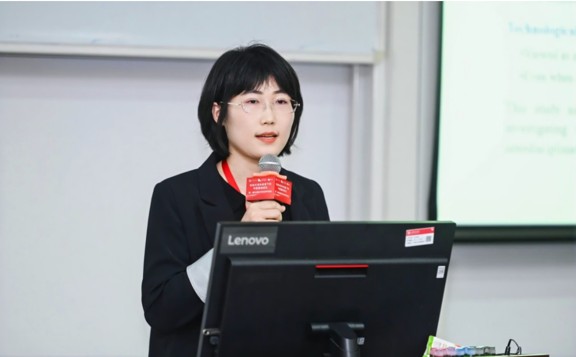
Li Bing holds a PhD in Management and is a lecturer at the School of Information Resource Management, Faculty of History. She earned her doctorate through a joint program between Dalian University of Technology and Université de Montréal, Canada. Her research centers on scientific and technical intelligence and scientometrics. She has published over ten papers in major journals such as the Journal of the China Society for Scientific and Technical Information, Information Studies: Theory & Application, and Scientometrics, and has taken part in several projects funded by the National Natural Science Foundation of China and the National Social Science Fund of China.
Translated by: Li Xinyuan
Edited by: Gao Mengdi, Liu Hanlin
Proofread by: Li Zhibin
Reviewed by: Jin Jinghua