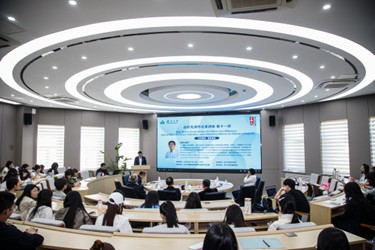
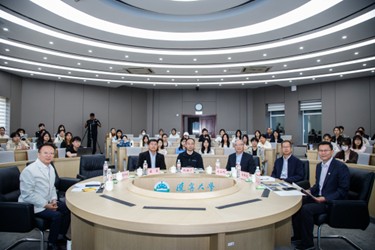
On the morning of September 14, the 11th Bai Qinxian Distinguished Overseas Scholars Lecture of Liaoning University (LNU) was held in Room 401 of the Administration Building at the Puhe Campus. Professor Sheng Yu, Professor at the Crawford School of Public Policy of the Australian National University, Professor at the School of Advanced Agricultural Sciences of Peking University, and Deputy Director of the China Center for Agricultural Policy, was invited to deliver an academic report entitled “Why Better Seeds Reduce Fertilizer Use Efficiency—Hybrid Rice, Fertilizer Subsidies, and Offsetting Effects on Nitrogen Demand.” Professor Qiu Huanguang, Secretary of the Party Committee of LNU, attended the lecture, which was moderated by Professor Zhao Deqi, Dean of the Asia-Australia Business College of LNU.
Under the title “Why Better Seeds Reduce Fertilizer Use Efficiency—Hybrid Rice, Fertilizer Subsidies, and Offsetting Effects on Nitrogen Demand,” Professor Sheng Yu centered his lecture on the relationship between rice yield increases and green agricultural development. Starting from the promotion of hybrid rice and changes in nitrogen fertilizer input, he explored how breeding innovation, farmers’ production decisions, and agricultural support policies jointly shape nitrogen fertilizer demand. He pointed out that understanding fertilizer application behavior in agricultural production requires attention not only to the nitrogen uptake and utilization characteristics of crop varieties, but also to the roles of input prices, subsidy incentives, and output growth.
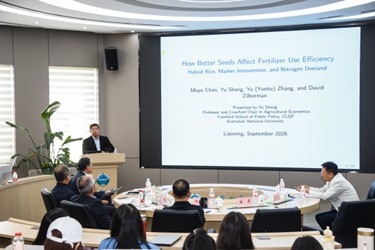
He noted that the impact of breeding technology change on nitrogen fertilizer use needs to be understood in terms of the interplay between technology and policy. In the historical sample examined in the study, nitrogen use efficiency traits were declining at the same time as nitrogen application was rising. Model analysis, however, showed that, if policy responses are not taken into account, the adjustment in input use caused by trait changes alone would have reduced nitrogen fertilizer demand; subsidy incentives offset this effect by lowering the actual cost of nitrogen fertilizer use, while output expansion further increased nitrogen demand. Thus, the direct effect of technological change may well diverge from the fertilizer application outcomes ultimately observed.
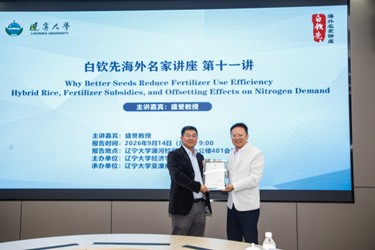
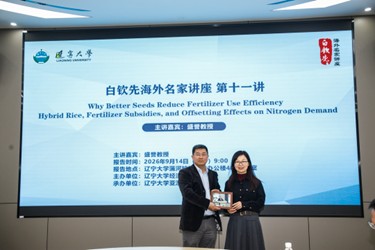
After the lecture, Professor Dong Baomin, Deputy Director of the Faculty of Economics of LNU, presented Professor Sheng Yu with a commemorative certificate of the Bai Qinxian Distinguished Overseas Scholars Lecture, and Professor Ma Yali, Deputy Dean of the Asia-Australia Business College of LNU, presented him with a commemorative photo.
The lecture was hosted by the Faculty of Economics of LNU and organized by the Asia-Australia Business College, with representatives of faculty and students from relevant units of the Faculty of Economics in attendance. Focusing on resource utilization in agricultural production, the event combined the genetic characteristics of crop varieties with economic incentives, offering faculty and students a research perspective for understanding the relationship between technological innovation and green agricultural development.
Speaker Profile
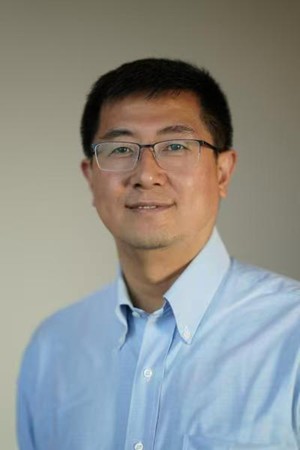
Sheng Yu is Professor and Crawford Chair in Agricultural Economics at the Crawford School of Public Policy of the Australian National University, Professor at the School of Advanced Agricultural Sciences of Peking University, and Deputy Director of the China Center for Agricultural Policy. He holds a PhD in Economics from the Australian National University. His main research areas include science and technology policy and agricultural productivity, rural transformation and sustainable agricultural development, the impact of climate change on global agriculture, and agricultural trade and policy analysis. Professor Sheng Yu serves as Co-Editor of the Australian Journal of Agricultural and Resource Economics, and his research has been published in journals such as the American Journal of Agricultural Economics and World Development.
Translated by: Li Xinyuan
Edited by: Gao Mengdi, Liu Hanlin
Proofread by: Li Zhibin
Reviewed by: Jin Jinghua