On September 14, 2026, the 20th session of Liaoning University’s Song Zexing Overseas Masters Lecture Series was held in Conference Room 401 of Administrative Building at Puhe Campus, Liaoning University (LNU). Professor Song Ligang from the Crawford School of Public Policy, Australian National University delivered an academic report titled “Global Structural Challenges and Implications for Global Long‑term Economic Growth”. Professor Qiu Huanguang, Secretary of the Party Committee of Liaoning University attended the lecture. Professor Zhao Deqi, Dean of the Asia‑Australia Business College presided over the event.
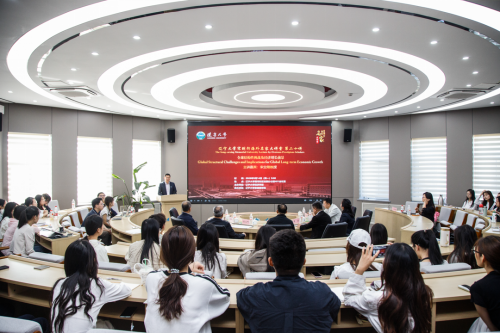
In his report, Professor Song Ligang conducted an in‑depth analysis of global structural challenges and long‑term economic growth prospects. He noted that the global economy is undergoing profound structural readjustment. Intertwined issues including sluggish labour‑productivity growth, demographic and labour‑force shifts, mounting debt levels, income inequality, de‑globalisation and geopolitical fragmentation, vulnerabilities within the financial system, energy and climate transition, and advances in artificial intelligence are continuously constraining long‑run global growth. He stressed that many current economic problems are no longer mere cyclical fluctuations. While conventional fiscal and monetary policies can mitigate short‑term shocks, they cannot fundamentally resolve structural contradictions. A reassessment of global economic growth is therefore required from multiple dimensions: social contracts, global governance, macroeconomic policies and technological transformation.
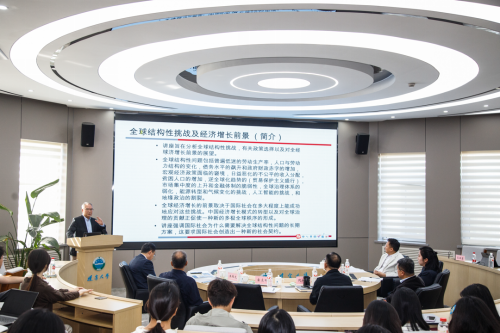
When discussing long‑term solutions, he argued that greater emphasis should be placed on technological progress and productivity gains, deepening supply‑side structural reform, improving the efficiency of factor allocation, and fostering further cooperation and integration across regional and global economies. He pointed out that artificial intelligence holds tremendous potential to boost productivity yet may simultaneously bring new risks such as income disparity, market concentration and financial hazards. A balance must therefore be struck between innovative development and risk governance. Turning to China’s economic transition, he observed that China is evolving from a technology adopter to a technology creator. Its growth drivers are increasingly shifting toward advanced manufacturing, scientific and technological innovation, green industries, domestic consumption and the service sector. China will play an expanded role in global economic growth and global governance.
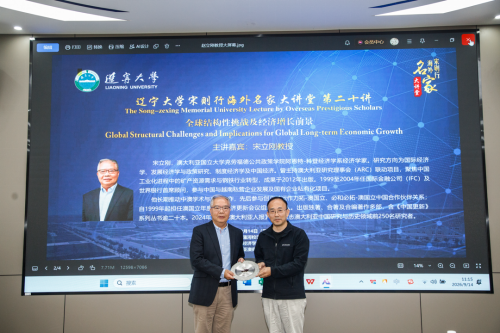
At the conclusion of the report, Professor Qiu Huanguang presented Professor Song Ligang with a commemorative plaque for the Song Zexing Overseas Masters Lecture Series.
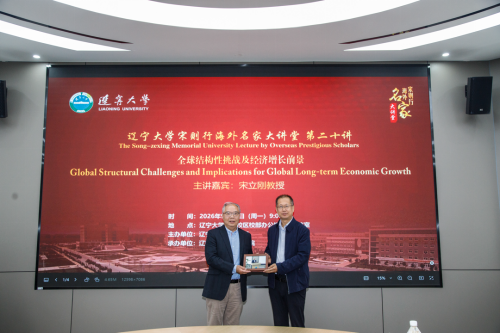
Professor Wang Weiguang, Deputy Director of the Faculty of Economics, presented Professor Song Ligang with a commemorative photograph.
Hosted by the Faculty of Economics of Liaoning University and undertaken by the University’s Asia‑Australia Business College, the lecture drew faculty and student representatives from relevant colleges and schools under the Faculty of Economics.
About the Speaker
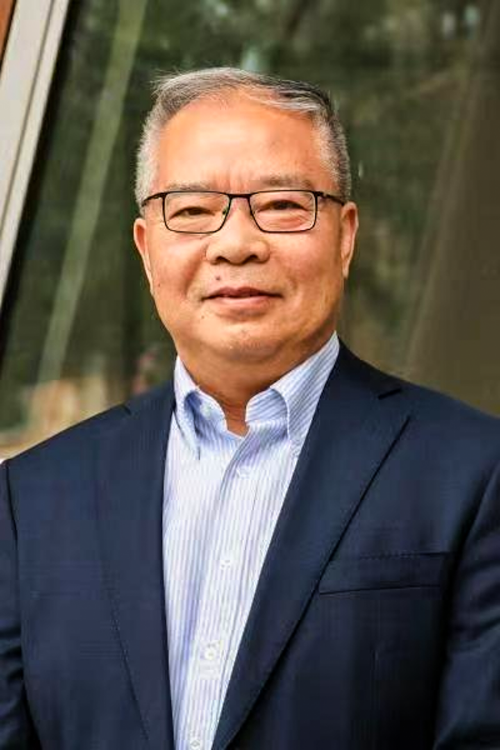
Song Ligang is a professor and PhD supervisor at the Arndt‑Corden Department of Economics, Crawford School of Public Policy, Australian National University. He also serves as Director of the China Economy Program. He holds a Bachelor’s degree in Economics from Renmin University of China, a Master’s degree in Economics from International University of Japan, and a Doctorate in Economics from the Australian National University. His research covers international economics, development economics and policy studies, institutional economics and the Chinese economy, in which fields he has produced substantial scholarly output.
He once led an Australian Research Council (ARC) Linkage Project examining China’s rapid industrialisation and its surging demand for mineral resources, with a special focus on the transformation of China’s steel industry; findings from this project were published in 2012. Between 1999 and 2004, he worked as a Chief Consultant for the International Finance Corporation (IFC) and the World Bank. He took part in projects supporting private‑sector development and state‑owned‑enterprise privatisation in China and Vietnam, and contributed to the landmark report “China’s Emerging Private Enterprises: Prospects for the New Century”. He was also one of the principal drafters for the feasibility study report for the Boao Forum for Asia prepared in 2000. From 2004 to 2017, he helped establish, develop and operate the Rio Tinto‑ANU China Partnership. Since 2018, he has been engaged in the BHP‑ANU China Partnership and the Bank of China (Sydney Branch) China Research Fellow Programme. Since 1999, he has served as a convener of the annual China Economy Update conference at the Australian National University. He is the author of Changing Global Comparative Advantage, and co‑author of Private Enterprises in China and Ownership Transformation in China. He has co‑edited volumes including China’s Accession to the WTO, China’s Third Economic Transformation, and The Transformation of China’s Steel Industry. Since 1999, he has co‑edited more than 20 volumes in the China Update book series. In 2024, he was listed among the top 250 researchers in Chinese studies and Chinese history in Australia by the research supplement of The Australian.
Translated by: Fu Zuoqi
Edited by: Gao Mengdi, Liu Hanlin
Proofread by: Li Zhibin
Reviewed by: Jin Jinghua