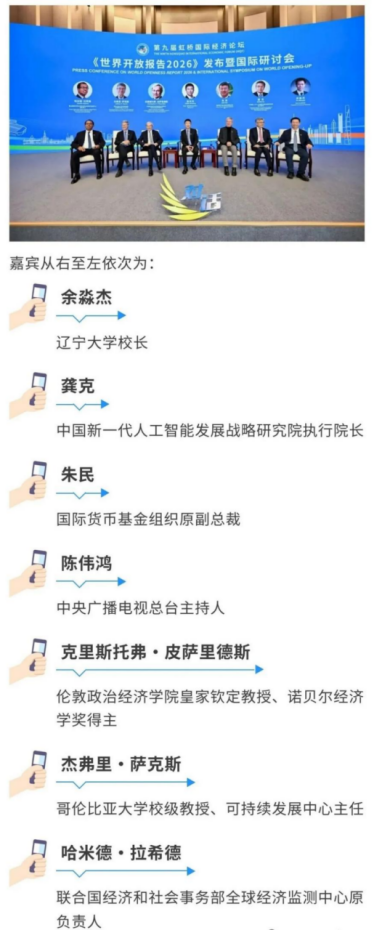
During the 9th China International Import Expo (CIIE), Professor Yu Miaojie, President of Liaoning University (LNU), was invited and interviewed by Dialogue, a CCTV Finance Channel talk show. Joining representatives of international organizations, experts and scholars, and leading industry figures, he shared his insights on what the World Openness Report 2026 reveals about the new foundation of global openness and cooperation.
Host: We have just witnessed the official release of the World Openness Report 2026. This report is like a golden key to measuring the economy and understanding trade. Let me first invite our guests to introduce, from their unique perspectives, what kind of report the World Openness Report is. From 1990 to 2025, the World Openness Index rose from 0.7046 to 0.7453, an increase of nearly 5.78 percent. This shows that the general trend of the index is still upward. In 2025, however, the index stood at 0.7453, down one percent year on year from 2024, also the largest drop in 16 years. What are the reasons behind this? We can point to four. The first is the rise of trade protectionism. The second is the prolongation of geopolitical conflicts. The third is the deep restructuring of global industrial chains. The fourth is the acceleration of regionalization.
Yu Miaojie: Personally, I think all four are important. But as for the most important factor behind the decline in world openness in 2025, it is the rise of trade protectionism. To make a comparison, US tariffs on Chinese products were 3.5 percent in 2017, about ten years ago. By this year in 2026, even the simplest and most conservative estimate reaches 26 percent. US tariffs on the rest of the world have also risen from 3.5 percent, the previous WTO rate, to around 15 percent today.
Host: President Yu, what improvements do you see in this year’s CIIE compared with previous years?
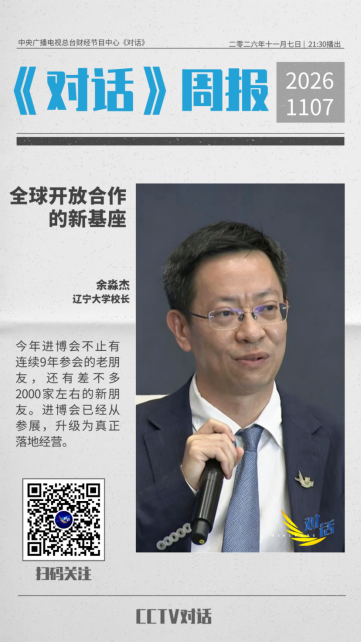
Yu Miaojie: First, I think this year’s CIIE has improved markedly in two respects, its scale and its structure. As the Chinese saying goes, “Is it not a joy to have friends come from afar?” We have seen not only some 200 old friends who have come for nine consecutive years, but also nearly 2,000 new friends this year. In terms of structure, we have seen several major changes. In the past, the CIIE was more of a product show, and now it is an innovation show. We have seen many world premieres, Asian premieres, and China premieres at this year’s expo, around 480 of them by our count. Second, in the past it was more about exhibiting, and now it is more about doing business. You can see it in Romania, for example, which set up a national pavilion and opened an office in Shanghai. That is real business.
Host: In this process of development, there is another issue we are concerned about. The dividends of AI development should not belong only to a few countries. For most countries, especially developing countries, how can we prevent a digital divide from emerging while the dividends of AI spread across the world?
Yu Miaojie: AI brings us many opportunities, but at the same time it may also turn out to be a black swan. Why do I say that? The development of artificial intelligence boils down to three core elements. The first is data, which you feed into it. The second is computing power, and behind computing power is electricity. The biggest contradiction we now face is that effective demand is abundant while supply is insufficient. In other words, electricity and computing power are mismatched in time, space, and efficiency. We do have a solution. Domestically, for example, if we can resolve the mismatch across time and space, that may point to building a unified national market. If efficiency improves, that may point to fostering new quality productive forces.
Translated by: Li Xinyuan
Edited by: Mark Moore
Proofread by: Li Zhibin
Reviewed by: Jin Jinghua