Guangming Daily has published a signed article by Professor Qiu Huanguang, Secretary of the CPC Committee of Liaoning University (LNU), titled “Contributing Strength of Higher Education Institutions to Advancing New Quality Productive Forces”.
The full text is as follows.
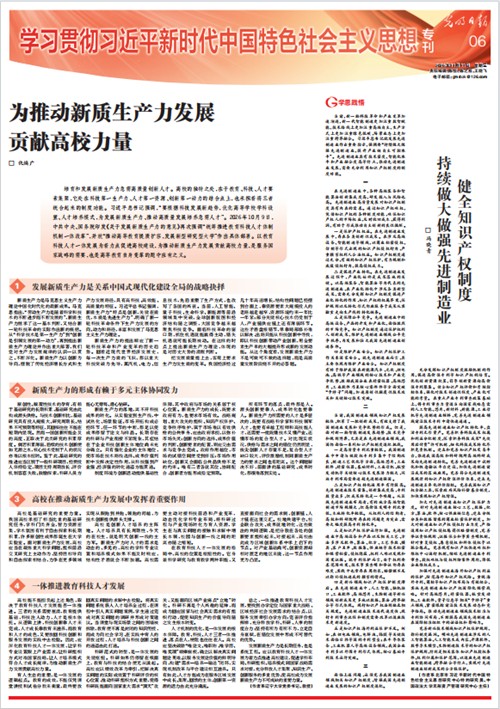
Contributing Strength of Higher Education Institutions to Advancing New Quality Productive Forces
Qiu Huanguang
Cultivating and developing new quality productive forces urgently require high-caliber innovative talent. What distinguishes universities lies in their agglomeration of education, science and technology, and talent. Positioned at the convergence of science and technology as primary productive forces, talent as the primary resource, and innovation as the primary driving force, universities also perform the institutional function of integrating these three pillars. General Secretary and President Xi Jinping stressed that “in light of new trends in scientific and technological advancement, we shall optimize discipline configuration and talent training models in institutions of higher education to cultivate urgently needed talent for developing new quality productive forces and advancing high-quality development”. On October 9, 2026, the Central Committee of the Communist Party of China and the State Council issued the Opinions on Developing New Quality Productive Forces, which reaffirms the need to “advance the integrated reform of the systems and mechanisms for developing education, science and technology, and talent in a coordinated way” and sets out specific arrangements for “improving the quality and expanding the capacity of higher education and developing new-type research universities.” Promoting university development by focusing on the integrated advancement of education, science and technology, and talent so that universities can contribute to the growth of new quality productive forces is not only a requirement for serving national strategies but also an inherent requirement of the transformation of higher education itself.
1. Developing New Quality Productive Forces Is a Strategic Choice That Bears on the Overall Cause of Chinese Modernization
New quality productive forces represent the latest achievement of adapting the Marxist theory of productive forces to the Chinese context and the needs of our times. Marx pointed out that “labour productivity develops alongside continuous advances in science and technology”. Inheriting this fundamental judgment, the theory of new quality productive forces offers a new summary grounded in the realities of the new round of scientific and technological revolution. From the proposition that “science and technology are primary productive forces” to the assertion that “innovation is the primary driving force for development”, and further to the formulation of the theory of new quality productive forces and major arrangements for its implementation, the CPC has maintained a consistent yet deepening understanding of the laws governing the development of productive forces. Innovation-oriented, new quality productive forces break away from traditional economic growth models and development paths for productive forces, and feature high-tech, high-efficiency, and high-quality attributes. General Secretary Xi stressed that for new quality productive forces, “its hallmark is innovation, its core lies in superior quality, and its essence is advanced productive forces”. This statement clarifies the direction, driving forces, and pathways for the development of productive forces amid the new round of sci-tech revolution, and enriches and develops the Marxist theory of productive forces.
The proposition of new quality productive forces responds to the historical trend of the new round of sci-tech revolution and industrial transformation. Looking back on the modern economic history of the world, every qualitative leap in productive forces has been preceded by major scientific and technological breakthroughs. Steam engines, electricity, and information technology have successively reshaped modes of production and altered the rise and fall of nations. At present, breakthroughs are being made simultaneously in frontier fields such as artificial intelligence, quantum technology, life sciences, and new energy, driving adjustments in the global innovation landscape and economic structure. Competition among major countries is increasingly centered on technological competition. At this critical window of opportunity in the sci-tech revolution, seizing it enables us to gain the initiative, while missing it may leave us in a passive position for a long time. Proposing the theory of new quality productive forces at this juncture reflects a sober assessment of the broader historical trend.
Improving the quality of development objectively requires a qualitative transformation of the productive forces. After decades of rapid growth, China’s economy now faces structural problems that have come to the fore. The traditional growth path reliant on large-scale inputs of resources and factors is increasingly untenable as resource and environmental constraints are tightening year by year. Some core and key technologies remain subject to external control, and there are still weak links in industrial and supply chains. These contradictions are interwoven and intricate, which cannot be resolved merely through piecemeal fixes. The only way forward lies in scientific and technological innovation: namely, to galvanize industrial innovation through sci-tech innovation and generate new drivers of growth by substantially lifting total factor productivity. From this perspective, fostering new quality productive forces is not an optional question but a compulsory one that cannot be bypassed in the stage of high-quality development.
2. Formation of New Quality Productive Forces Relies on Coordinated Efforts of Diverse Actors
The incubation of original and disruptive technologies hinges on long-term accumulation in basic research, which thereby serves as its source of supply. Compared with technological innovation, basic research features large investment scale, long research cycles, and uncertain outcomes, and its returns often fail to materialize in the short run. Yet the height that a nation’s innovation can reach is determined precisely by the depth of such accumulation. If accumulation is insufficient, subsequent technological innovation will be like water without a source, and the predicament of being subject to external control in core technologies can hardly be fundamentally reversed. In view of that, the advancement of basic research should be managed differently from ordinary research projects. Funding input must remain stable, project support cycles must be extended, and evaluation mechanisms must tolerate failures and encourage exploration, so that researchers can devote themselves undistracted to in-depth research.
The implementation of new quality productive forces is inseparable from the commercialization of scientific and technological achievements. From laboratories to production lines, pilot-scale testing and process maturation, scenario validation, and market expansion constitute indispensable stages. Disruption at any stage may leave scientific and technological achievements confined to papers and prototype samples. The root cause of the long-standing weak linkage between scientific research and industry lies in the failure to fully establish enterprises as principal actors in scientific and technological innovation. Only by reinforcing the principal role of enterprises and enabling the market to play a decisive role in selecting technological pathways and assessing the value of research outcomes can the transition channel from strength in science and technology to strength in industry and economy be unblocked.
The institutional environment provides fundamental safeguards for innovation activities, with the relationship between the government and the market lying at its core. The growth of new quality productive forces requires both a capable government and an effective market. Public affairs that markets cannot effectively supply — including strategic planning, the organization of major research breakthroughs, intellectual property rights protection, and the maintenance of competitive order — shall be undertaken by the government to remedy market failures. By contrast, the choice of innovation directions, the valuation of research outcomes, and the allocation of innovation factors shall be left to market demand and competition. Where the government overreaches, the room for market trial and error is squeezed; where the market underperforms, innovation is constrained by insufficient provision of public goods. Only when both play their respective roles and work in coordination can innovators develop stable expectations.
Ultimately, all links in the innovation chain boil down to people. Original innovation relies on talent, and so does the commercialization of scientific and technological achievements. New quality productive forces require multi-tiered talent, including strategic scientists and leading sci-tech talents; outstanding engineers and highly skilled personnel; and a cohort of interdisciplinary talents proficient in technology, industry, and the market. In reality, a pronounced mismatch remains between talent supply and demand. Top-notch innovative talent is in short supply, versatile professionals remain scarce, and evaluation and incentive mechanisms still fall short of the requirements for developing new quality productive forces. If this problem remains unresolved, the basic research and the commercialization of research outcomes discussed above will hardly yield concrete results.
3. Universities Play a Key Role in Boosting New Quality Productive Forces
Higher education institutions are a vital force in basic research. Chinese higher education institutions undertake a considerable share of basic research tasks, with a comprehensive range of academic disciplines, a dense concentration of intellectual resources, and an academic atmosphere conducive to free exploration and long-term accumulation. As a result, many original research outcomes have originated in university laboratories. To advance new quality productive forces, higher education institutions should act proactively to distill major scientific questions and organize frontier interdisciplinary research. They should combine goal-oriented research with free exploration, strive to move from following to running abreast and then to leading in more fields, thereby providing source-level support for technological innovation.
Higher education institutions serve as the main front for cultivating innovative talents. Talent cultivation follows a long cycle: students currently on campus will become the main force at the innovation frontline tomorrow. The demand for talent driven by new quality productive forces is dynamic and diverse. If higher education institutions fail to adjust their academic disciplines, specialties, and talent cultivation models in a timely manner, structural contradictions will continue to intensify. Higher education institutions need to proactively align with the frontiers of science and technology and industrial transformation, dynamically optimize the layout of their academic disciplines and specialties, and translate research processes and on-site industrial practices into resources for talent cultivation. As students develop their capabilities by engaging with and solving real-world problems, the gap between university campuses and the front lines of innovation will narrow accordingly.
Within the landscape of integrated development of education, science and technology, and talents, higher education institutions occupy a pivotal position. They perform the dual functions of scientific research and teaching, are directly oriented toward societal demand, and serve as a convergence point of the innovation chain and the talent chain. The common logic behind practices such as platforms jointly built by universities and local governments, university-industry collaborative research on key technologies, and local commercialization of research outcomes is to organize and connect dispersed innovation factors, thereby positioning higher education institutions as bridging nodes in the regional innovation system. For regions with a relatively sound industrial foundation yet scarce innovation resources, this nodal role becomes even more prominent.
4. Coordinated Advancement of Education, Sci-Tech, and Talent Development
Whether higher education institutions can fulfill these roles depends on whether the development of education, science and technology, and talent can be advanced in an integrated manner. The relationship among the three must be clarified — education provides the foundation, science and technology injects driving force, and talent serves as the fundamental support. Logically, scientific and technological innovation depends on talent, whose growth is nurtured by education; in turn, the quality of education and talent development must be tested in the practice of scientific and technological innovation and in serving development. Therefore, we should deepen the integrated development of education, science and technology, and talent to ensure that discipline and specialty setup keeps pace with industrial demand, that models of scientific research organization are aligned with national strategies, and that talent training models conform to the laws governing talent growth, thereby contributing the strengths of higher education institutions to advancing new quality productive forces.
Reshaping the talent cultivation ecosystem is the logical starting point for integrated development. Educational effectiveness cannot be measured solely by classroom instruction and exam scores. Instead, it must be tested in the resolution of real-world problems, which should be systematically embedded throughout the whole process of talent cultivation. Real-world cases are incorporated into courses, enabling students to conduct research on these problems and formulate recommendations. Once the barriers between classrooms and real-world settings are removed, education is no longer a closed process of knowledge transmission but an open process of learning from society and cultivating talent through practice, thereby connecting talent cultivation with scientific and technological innovation.
The transformation of the scientific research paradigm serves as the key pivot for integrated development. If research remains confined to papers, there can be no meaningful integration of education and science and technology. Higher education institutions should use performance reform as a lever, place the practical outcomes of solving real-world problems at the core of research evaluation, and drive the reshaping of research organization models. This will enable research to both reach new heights in tackling major national needs and translate outcomes into practical applications that address regional industrial pain points. Research is no longer merely an extension of personal interests but an organized endeavor responsive to the real needs of the country and society, thereby driving a fundamental shift in the value orientation of knowledge production.
Optimizing talent mechanisms provides the fundamental guarantee for integrated development. The integrated advancement of education, science and technology, and talent ultimately depends on people, and the obstacles to it often lie in people. Higher education institutions must resolutely eradicate the entrenched malpractice of evaluating talent solely through papers, professional titles, academic qualifications, and awards. They should establish a clear orientation that takes the problem-solving ability as the measure of merit and contribution to development as the measure of value, build a closed loop connecting demand, cultivation, and delivery, and enable institutional reform and platform development to reinforce each other. Only in this way can talent become the principal force that grows, clusters, and gives back while serving regional development, thereby fully unleashing the vitality of talent as the primary resource for innovation.
In conclusion, advancing the integrated development of education, science and technology, and talent requires higher education institutions to identify the convergence point between their institutional positioning and major national strategies as well as regional economic and social development needs, and to steer their educational orientation toward serving development. They should refine the evaluation baton to fully unlock institutional synergy across disciplines, scientific research, and personnel systems. They should take a selective approach, build on their inherent endowments, and pursue differentiated development to cultivate irreplaceable strengths.
Developing new quality productive forces is a long-term, systematic task. The integrated development of education, science and technology, and talent should therefore be taken as the focal point for advancing higher education institutions. This requires aligning the layout of academic disciplines and specialties, the organization of scientific research, and talent cultivation models with national strategic needs, and fully leveraging the multiple advantages of talent clustering, knowledge production, and innovation services, so that higher education institutions can become an indispensable force in developing new quality productive forces.
About the Author

Qiu Huanguang is a Distinguished Professor under a national talent program and an expert receiving the State Council Special Allowance. He is currently the Secretary of the CPC Committee of Liaoning University, Vice President of the Chinese Association of Agro-Technical Economics, and Chair of the Youth Working Committees of both the Chinese Association of Agricultural Economics and the Chinese Society for Rural Development. He was selected into the first cohort of the National Science Fund for Excellent Young Scholars and the first batch of national-level youth talent programs.
His main research areas include agricultural economics, rural development, and resource and environmental economics and policy. He has led more than 10 projects funded by the National Natural Science Foundation of China and the National Social Science Fund of China. He has published over 240 academic papers in domestic and international journals, including more than 80 SCI/SSCI papers in international journals such as the Proceedings of the National Academy of Sciences, and over 160 papers in leading Chinese journals such as Economic Research Journal, Journal of Management World, and China Economic Quarterly. He has authored or edited 15 monographs in Chinese and English. His honors include the Second and Third Prizes of the Ministry of Education Humanities and Social Sciences Outstanding Achievement Award, the First Prize of the Ministry of Agriculture and Rural Affairs Soft Science Research Award, the China Rural Development Research Award, and the Zhang Peigang Development Economics Award.
Translated by: Zeng Xi
Edited by: Mark Moore
Proofread by: Mu Xiaolin
Reviewed by: Jin Jinghua