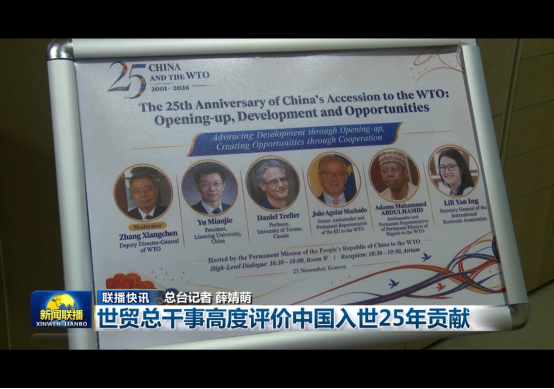
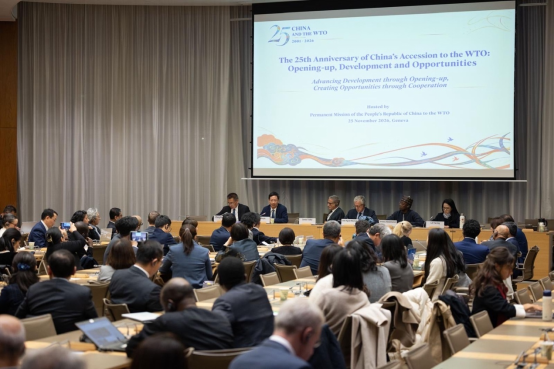
On November 25, the high-level dialogue themed “25th Anniversary of China's WTO Membership: Opening-up, Development and Opportunities,” hosted by the Permanent Mission of the People's Republic of China to the World Trade Organization (WTO), was held at the WTO headquarters in Geneva, Switzerland. The dialogue brought together distinguished Chinese and international experts and scholars to discuss China's opening-up practices, development achievements and contributions to the world since its accession to the WTO, and to explore ways to better safeguard the multilateral trading system and promote universally beneficial and inclusive economic globalization. Ambassador Li Yongjie, China's Permanent Representative to the WTO, chaired the opening session, while WTO Deputy Director-General Zhang Xiangchen moderated the discussion. More than 200 participants attended the event, including ambassadors and deputy representatives of major WTO members, as well as representatives of international organizations, media outlets and think tanks.
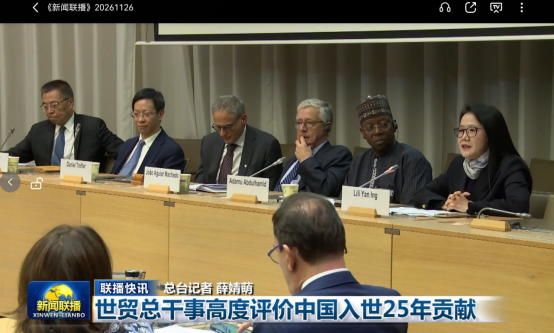
Li Chenggang, China International Trade Representative and Vice Minister of Commerce, and WTO Director-General Ngozi Okonjo-Iweala delivered opening remarks. Yu Miaojie, President of Liaoning University; Daniel Trefler, Professor at the University of Toronto; João Aguiar Machado, former Ambassador of the European Union to the WTO; Adamu Mohammed Abdulhamid, Ambassador of Nigeria to the WTO; and Lili Yan Ing, Secretary General of the International Economic Association, exchanged views on the theme of the dialogue.
Yu Miaojie spoke on China's economic development achievements and its experience in reform and opening-up over the past 25 years since joining the WTO. He noted that China's accession to the WTO was a historic milestone in the country's reform and opening-up, marking a new stage in its integration into the global economy. Over the past 25 years, China has promoted reform and development through opening-up, continuously deepened domestic reform and expanded opening-up, and made historic achievements in economic development. From the product, firm and industry levels to the economy-wide level, the contribution of China's WTO accession to its economic development is reflected in six main aspects.
First, increasing the value-added content of Chinese products. In 2001, the value-added share of Chinese products was approximately 50%, compared with 79% today. Meanwhile, China's trade structure has undergone significant changes, with the share of relatively low-productivity processing trade declining from 50% in 1998 to roughly 18% today. These changes reflect the steady improvement in the quality of China's foreign trade.
Second, improving the quality of Chinese products. According to research estimates, taking the quality of Chinese products in 2001 as the baseline, product quality improved by approximately 30% in the first decade following China's WTO accession and by another 20% in the second decade. Over the past 25 years, China has achieved significant improvements in product quality while expanding its trade volume.
Third, enhancing the total factor productivity of Chinese firms. Empirical research shows that trade liberalization in both final and intermediate goods has significantly increased the productivity of Chinese firms. Before the 2008 global financial crisis, trade liberalization accounted for approximately 14% of China's economic growth.
Fourth, helping China develop complete industrial and supply chains. According to China's industrial classification system, the country currently has 41 industrial divisions, 207 industrial groups and 666 industrial classes. Since China's accession to the WTO, its industrial system has continued to diversify and improve. The development of emerging industries such as new materials, aerospace and high-end transportation equipment has further strengthened China's industrial and supply chains.
Fifth, promoting the development of industrial clusters and the realization of economies of scale. Before joining the WTO, China had relatively few national-level industrial clusters. Today, the country has more than 1,000 such clusters. The development of industrial clusters has helped China realize economies of scale and has become an important driver of its industrial development.
Sixth, promoting China's economic growth and social progress. This progress is reflected in three key areas: GDP per capita, foreign trade and poverty reduction. China's GDP per capita has increased from less than US$1,000 in 2001 to nearly US$14,000 today. Its foreign trade has expanded significantly, with total trade volume now reaching approximately US$6.5 trillion. In 2001, approximately 90 million people in China were living in poverty. Today, China has achieved the historic feat of eradicating absolute poverty. These achievements demonstrate the important role of China's WTO accession in promoting economic growth and social development.
In summarizing China's experience in reform and opening-up since its accession to the WTO, Yu highlighted three key concepts: gradual reform, pragmatic opening-up and the principle of non-discrimination.
First, advancing reform and opening-up in a gradual and orderly manner. In the early 1980s, China established four special economic zones, including Shenzhen, marking the initial breakthroughs in its opening-up. In 1984, China opened another 14 coastal cities, extending opening-up along the coast. Subsequently, opening-up was gradually extended to inland provincial capitals. China's opening-up thus progressed from individual points to lines along the coast and eventually to broader areas across the country. This process illustrates the gradual nature of China's reform and opening-up.
Second, pursuing pragmatic opening-up based on China's national conditions. In the initial stages of opening-up, China did not prioritize trade in services. Instead, it started with manufacturing and actively developed processing trade. Despite its relatively low productivity, processing trade created employment opportunities and helped gradually improve firms' profitability. This illustrates China's pragmatic approach to opening-up.
Third, adhering to the WTO's principle of non-discrimination. Since joining the WTO, China has continued to advance trade liberalization and reduce tariff levels. In 2001, China's average tariff rate was 15.1%. Today, its simple average tariff rate has fallen to 7.1%, while its trade-weighted average tariff rate stands at only 3.3%. Some estimates suggest that China's effective tariff rate is even lower, at approximately 1.3%. Meanwhile, China has gradually removed relevant non-tariff restrictions, including the elimination of quotas on trade in textiles and clothing in 2005. These measures demonstrate China's commitment to observing WTO rules.
Yu noted that gradual reform, pragmatic opening-up and adherence to the principle of non-discrimination are three important features of China's reform and opening-up. China's development experience over the past 25 years since joining the WTO demonstrates how deepening domestic reform and expanding opening-up can reinforce each other, and offers valuable insights into the relationship between trade liberalization and economic and social development.